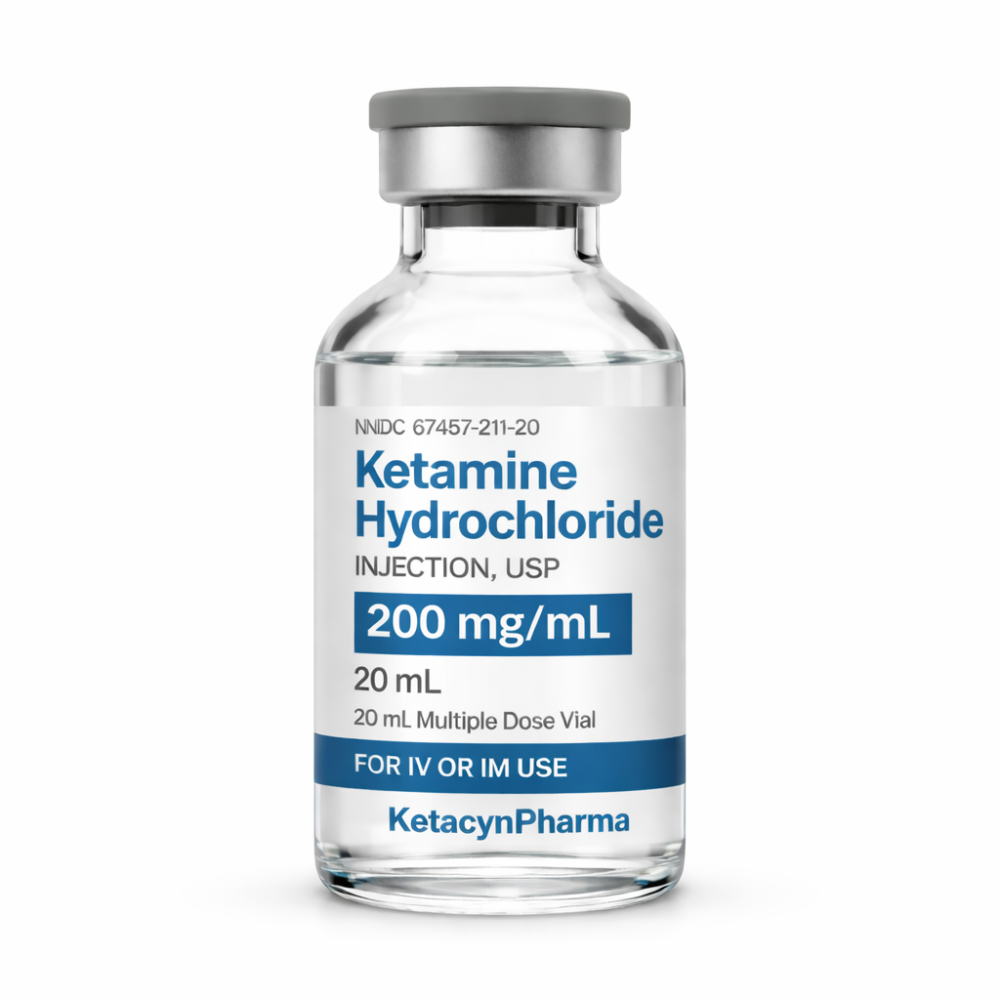
Injection
Ketamine HCL 200 mg/ml Injectable – 20 ml Vial
- Ships in 1 to 2 business days. Free shipping over $500.
- Your purchase funds independent research.
- 30-day returns on unopened items.
Ketamine HCl: Understanding Its Medical Applications, Research Value, and Product Information
Ketamine HCl: An Introduction to This Important Research Compound
Ketamine HCl (ketamine hydrochloride) is a pharmaceutical compound that has attracted significant medical and scientific interest because of its effects on the central nervous system. Healthcare professionals use ketamine in specific anaesthetic settings, while researchers investigate its potential applications in pain pathways, neuroscience, and mental-health treatment.
Its importance comes from its distinctive pharmacological activity, particularly its interaction with NMDA receptors. This mechanism separates ketamine from traditional opioid pain medicines and makes it an important subject in modern medical research.
At KetamineResearchLabs, we recognise the importance of accurate information, product identification, and responsible scientific inquiry. This guide explores ketamine HCl, its medical relevance, research applications, and the precautions associated with it.
What Exactly Is Ketamine Hydrochloride?
Ketamine hydrochloride is the hydrochloride salt form of ketamine. The compound belongs to a class of medicines known as dissociative anaesthetics.
Ketamine primarily blocks N-methyl-D-aspartate (NMDA) receptors, which respond to glutamate, one of the brain’s major excitatory neurotransmitters.
These receptors participate in several neurological processes, including:
- Communication between nerve cells.
- Learning and memory.
- Pain-signal processing.
- Changes in neural connections.
- Regulation of certain central nervous system activities.
By influencing NMDA receptor activity, ketamine can produce anaesthesia, dissociation, and changes in pain perception.
Why Is Ketamine HCl Important in Medical Science?
Ketamine has an established role in anaesthesia and several areas of continuing clinical investigation.
1. Anaesthesia and medical procedures
Clinicians use ketamine in selected medical procedures because it produces a dissociative anaesthetic state. It can provide sedation and analgesia while producing a different pattern of cardiovascular and respiratory effects from many other anaesthetic agents.
Healthcare professionals select and administer it according to the patient’s condition, procedure, and monitoring requirements.
2. Pain-management research
Researchers investigate ketamine because NMDA receptors participate in central pain processing. These receptors may contribute to sensitisation, a process in which the nervous system becomes increasingly responsive to painful stimulation.
Ketamine’s effects on this pathway have encouraged research into selected acute and persistent pain conditions. However, its suitability depends on the individual patient and clinical circumstances.
3. Mental-health research
Ketamine and its related prescription formulations have also attracted interest in psychiatry.
Esketamine nasal spray has FDA-approved indications for certain adults with depression. Treatment requires medical supervision and specific safety monitoring.
This approval does not mean that every ketamine HCl product, formulation, or route of administration has the same indication.
Ketamine Cream: Understanding Topical Formulations
Ketamine cream is a topical formulation designed for application to the skin. Researchers have investigated compounded topical ketamine for certain localised pain conditions, particularly neuropathic pain.
Neuropathic pain develops when disease or injury affects the nerves or nervous system. Symptoms can include burning, tingling, shooting sensations, and sensitivity to touch.
Why do researchers investigate topical ketamine?
Ketamine interacts with NMDA receptors involved in pain signalling. Researchers have explored whether topical formulations could influence certain local pain pathways.
A topical formulation also provides a different route from an injection or nasal spray. However, applying a medicine to the skin does not guarantee that it remains entirely local or prevents systemic absorption.
What are the limitations?
The clinical evidence for compounded topical ketamine remains limited and inconsistent. Researchers have not established it as a reliable general treatment for neuropathic pain, and it is not FDA-approved as a finished topical medicine.
Patients should not use research-grade ketamine HCl to prepare creams or apply laboratory materials to their skin. A qualified healthcare professional should evaluate any proposed compounded treatment.
Ketamine HCl: Important Safety Considerations
Ketamine can cause several adverse effects, particularly when used outside appropriate medical supervision.
Possible effects include:
- Dissociation and altered perception.
- Dizziness and confusion.
- Nausea and vomiting.
- Increased blood pressure and heart rate.
- Sedation.
- Respiratory complications in certain circumstances.
- Misuse, dependence, and other complications with repeated nonmedical use.
Clinicians consider a patient’s medical history, cardiovascular health, medications, and other risk factors before administering ketamine.
Ketamine should not be used as a self-directed treatment or combined with other sedating substances without medical advice.
Ketamine HCl and Other Ketamine Formulations
The term ketamine HCl describes a chemical salt form, while product formulations describe how a medicine or research material is presented.
| Formulation | General description |
|---|---|
| Ketamine hydrochloride injection | Prescription formulation used in supervised medical settings |
| Esketamine nasal spray | Prescription medicine with specific FDA-approved indications |
| Compounded topical ketamine cream | Custom-prepared formulation investigated for selected pain conditions |
| Research-grade ketamine materials | Materials intended for authorised scientific investigation, not automatically for human use |
These products are not interchangeable. Their quality requirements, regulatory status, intended uses, and evidence differ.
What Makes Product Documentation Important?
Product identity and documentation matter in scientific research. Researchers need accurate information about the material they study and the standards used to evaluate it.
Important documentation may include:
- Chemical identity and stated composition.
- Batch or lot identification.
- Certificate of Analysis (COA), where applicable.
- Relevant purity and analytical testing information.
- Storage and handling information.
- Intended-use and regulatory statements.
A Certificate of Analysis can provide useful batch-specific information, but it does not establish that a product is approved or safe for human treatment.
Explore Ketamine Research Products at KetamineResearchLabs
KetamineResearchLabs is committed to providing research-focused product information and supporting responsible scientific inquiry.
Through KETAMINERESEARCHLABS.COM, visitors can explore our LabsStore and review available product categories and documentation.
Our approach emphasises product transparency, clear descriptions, and attention to applicable regulatory requirements. Customers should verify the intended purpose and legal status of each item before considering an order.
Research materials must not be presented as approved medicines or substitutes for professional healthcare.
For individuals interested in prescription ketamine treatment, qualified healthcare professionals can explain authorised formulations, clinical suitability, and appropriate supervision.
Frequently Asked Questions About Ketamine HCl
What does HCl mean in ketamine HCl?
HCl stands for hydrochloride. It identifies the salt form of ketamine used in certain pharmaceutical and research formulations.
Is ketamine HCl used in hospitals?
Yes. Ketamine hydrochloride has an established role in anaesthesia and is used by qualified healthcare professionals in appropriate medical settings.
Is ketamine HCl the same as esketamine?
No. Ketamine and esketamine are related but distinct compounds. Esketamine is one of ketamine’s enantiomers and has specific prescription indications.
Is ketamine cream FDA-approved?
No. Compounded topical ketamine is not FDA-approved as a finished topical medicine. Evidence for its effectiveness remains limited.
Where can I find KetamineResearchLabs product information?
Visit KETAMINERESEARCHLABS.COM and explore the LabsStore for available product descriptions and relevant documentation.
Stay Informed for Your Health and Well-Being! SHOP NOW
Ketamine HCl remains an important compound in anaesthesia, neuroscience, and ongoing medical research. Its distinctive interaction with NMDA receptors has helped researchers investigate pain signalling and other neurological processes.
At KetamineResearchLabs, we value accurate information, responsible scientific inquiry, and transparent product documentation.
Explore our LabsStore and available research information at:
Website: KETAMINERESEARCHLABS.COM
Email: [email protected]
Stay informed for your health and well-being! SHOP NOW.
Make informed decisions, follow applicable regulations, and consult qualified healthcare professionals about medical treatment.
Shipping
- Standard delivery takes 3 to 5 business days and is free on orders over $500.
- Express delivery takes 1 to 2 business days.
- Institutional items ship by tracked freight after we verify your organisation.
- Digital products arrive as a download link by email once payment clears.
Returns
Return unopened items within 30 days for a full refund. Opened consumables and digital products are not returnable. Instruments that arrive damaged or out of specification are replaced at our cost.